Chelsea_Sun ・ Jan. 22, 2026
More than 100 family office heads, fund managers and Web3 investors gathered in Hong Kong on Friday for the closed-door launch of Dewu Finance, an event widely seen as the first substantive effort to turn China’s vast supply chain cash flows into compliant, tokenised assets for global investors under the city’s regulatory framework.
Officials from Invest Hong Kong (InvestHK), the city’s investment promotion agency known for its cautious approach, made a rare appearance, underscoring the significance of the event for Hong Kong’s ambition to build a regulated tokenisation ecosystem.
Dewu Finance’s managing partner Ding Boran, a young financier, pointed out a persistent anomaly in global markets: investors would buy U.S. bonds with a 4% yield but shy away from real trade assets on China's supply chain with a yeild of about 10%.
“Trillions of Chinese yuan in trade assets are being systematically mispriced,” Ding told the audience. “Not because the risk is high, but because global capital cannot see them clearly or access them efficiently.”
China accounts for roughly 30% of global manufacturing output, generating enormous volumes of accounts receivable as goods move through supply chains linking exporters, suppliers and overseas buyers. Industry data show default rates among top-tier manufacturers and their first-tier suppliers are relatively low, yet many of these assets struggle to attract financing beyond traditional bank channels.
Investors, Ding argued, often prefer U.S. Treasuries with a yield of about 4% rather than trade-linked assets that can offer annualised returns of about 10%, reflecting what he called a “structural distortion” rooted in opacity and access barriers.
Traditional lenders, he said, rely heavily on collateral and balance sheets, whereas supply chain finance depends on understanding the circulation of goods, contracts and payments. Small and mid-sized suppliers frequently face funding gaps despite having reliable counterparties, resulting in what Dewu sees as chronic undervaluation.
Dewu Finance’s solution is to bridge that gap by packaging these cash flows into standardised, investable products using digital infrastructure and blockchain-based verification, while operating within Hong Kong’s regulatory framework.
The platform’s model is powered by two key engines showcased at the launch.
The first is QQT, a Chinese digital procurement and supplier relationship management platform that overtook SAP Ariba to become the market leader in China in 2023, according to industry rankings. Founded by Xu Hui, QQT connects more than 1,000 large corporates — including Xiaomi, BOE, Haier and Hikvision — with about 3 million suppliers. Annual transaction volumes on its platform exceed 5 trillion yuan (about $700 billion).
Through SRM (Supplier Relationship Management), QQT captures detailed, real-time data across the procurement chain, from contracts and purchase orders to shipping records and invoices. Dewu uses this information to identify receivables linked to core enterprises, giving investors what Xu described as a “god’s-eye view” of asset quality.
“This isn’t a bet on a single company’s credit,” said one fund manager attending the event. “It’s an anchor to the fundamentals of China’s manufacturing base.”
The second engine is Flyway, a cross-border payments firm serving Chinese exporters selling on platforms such as Amazon, Temu and DHgate. These transactions typically have short settlement cycles of two to four weeks, high turnover and payments that can be contractually secured.
Ding said Dewu does not rely on borrower creditworthiness in this segment, but instead locks in expected settlement proceeds from e-commerce platforms. “As long as the goods are sold, the payment is there,” he said, describing the assets as “self-liquidating.”
Backed by QQT and Flyway and through combining longer-dated domestic supply chain assets with short-duration cross-border receivables, Dewu builds diversified pools across tenors and currencies, supporting liquidity while smoothing volatility.
Dewu Finance's Moat
For many institutional investors, the appeal of underlying assets is secondary to questions of governance, verification and cross-border compliance — areas where numerous finance projects have stumbled. The ability to ensure the authenticity of assets and trans-border compliance is the moat of Dawu Finance.
Dewu executives stressed that the firm positions itself not as an intermediary, but as an asset manager applying technology to risk control. They introduced AI agents to replace humans for 24/7 dynamic monitoring. AI tools monitor invoices, logistics data and transaction flows around the clock, pushing oversight from the corporate level down to individual orders, the firm said.
On regulation, Dewu has partnered with Hong Kong-licensed fintech firm Evident to structure issuance and distribution in line with Securities and Futures Commission (SFC) requirements. "We don't touch fund pools. Every cent moves through regulated channels such as qualified foreign limited partner (QFLP) schemes or licensed institutions," said Ding.
The platform also emphasises a “three-flow” closed loop: information flow derived from QQT’s data, physical logistics verified through shipping records, and capital flow controlled via entrusted payments and locked repayment mechanisms. These elements are bound together on-chain to convert non-standard receivables into standardised tokenised units.
Dewu Finance values transparency as much as efficiency. Dewu uses the Polygon network as a verification layer, recording cryptographic proofs — including zero-knowledge proofs — that allow third parties to confirm authenticity without revealing underlying details.
Beach Landing
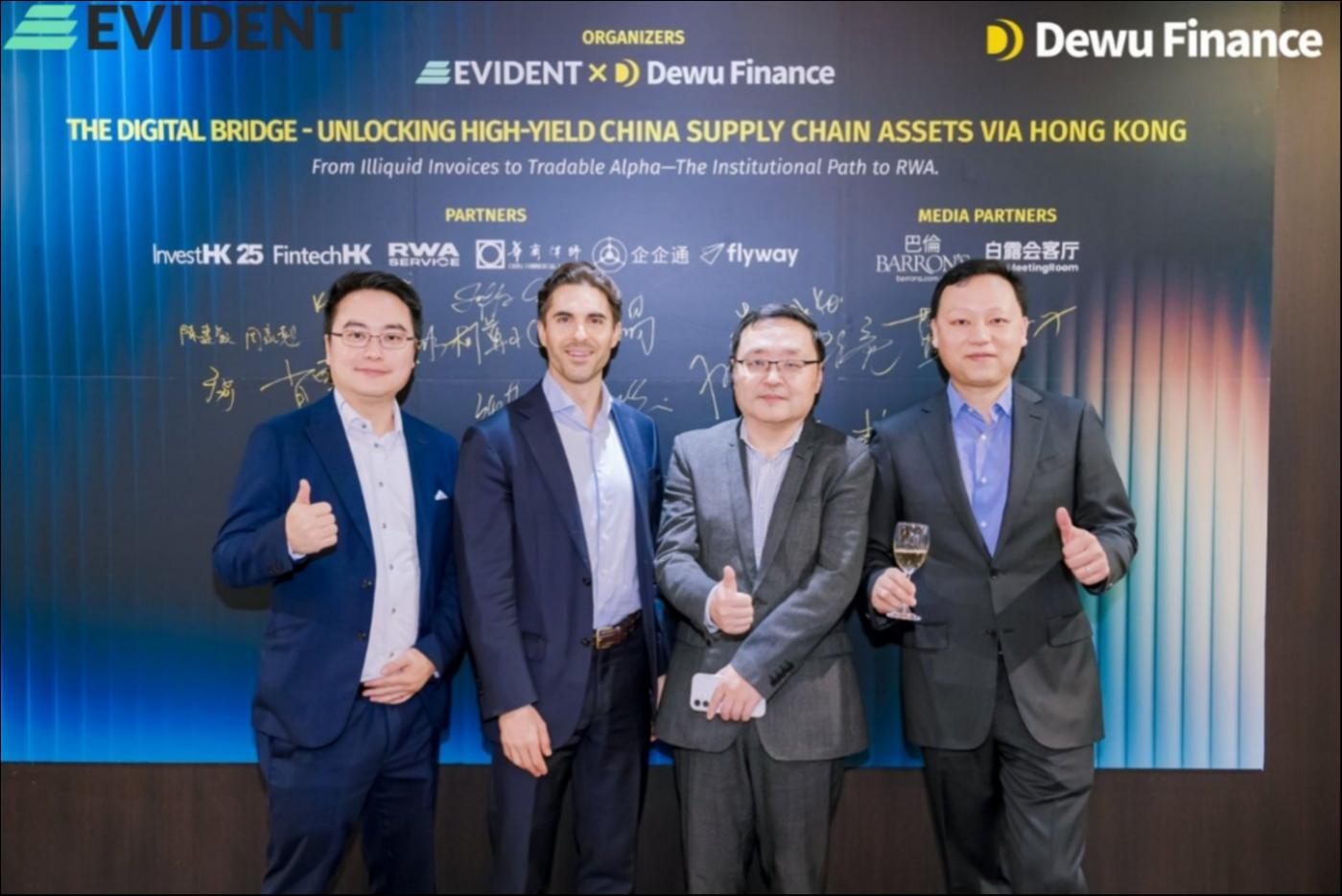
Evident Head of Investment Solutions Manton WAI,Evident Founder & CEO Florian M Spiegl,Dewu Finance's Managing Partners Ian Lee and Ding Boran
The launch was concluded with applause, which was a tribute not only to speakers on the stage but also to an era where tokenization is going from concept to application.
In the global asset landscape of 2026, Dewu Finance offers a highly compelling option: it combines the stability of fixed-income–like instruments with alpha returns that significantly outperform U.S. Treasuries, while also incorporating a design that balances equity-style liquidity with upside potential. Rooted in China’s real economy, it connects to the global market through Hong Kong.
Prolonged undervaluation often reflects the lack of a common language rather than intrinsic risk. If an asset is cheap for long enough, it’s usually because the market doesn’t know how to price it, Ding noted.
Attendees described the launch as a milestone in shifting tokenisation from concept to application. With advanced technology and strict compliance, Dewu Finance, led by Ding, is communicating global investors about how to understand the value of China's supply chains. For smart investors, Dewu Finance may be an admissions ticket for the club of revaluation.
 LIKE 1