zhangxinyue ・ Aug. 18, 2025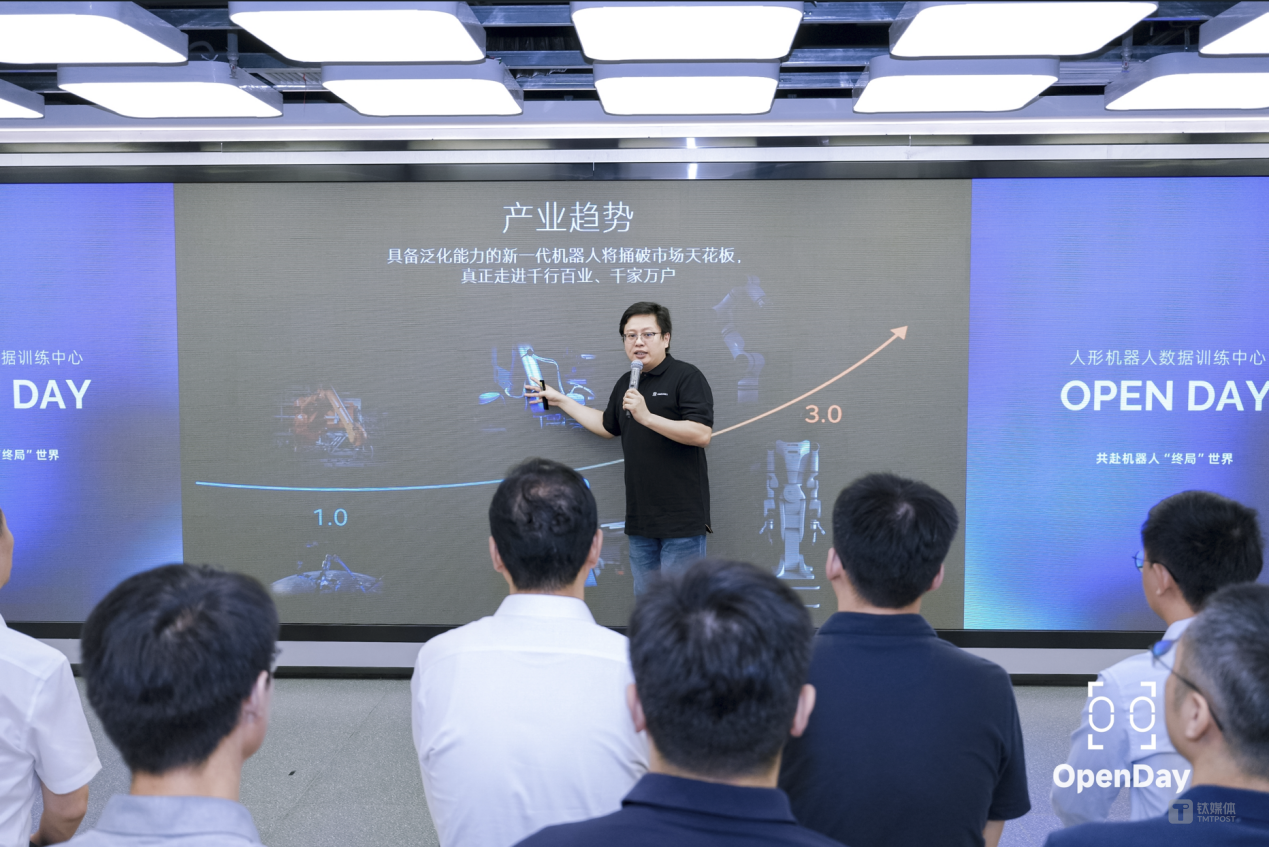
Zheng Suibing, Head of the Humanoid Robot Data Training Center Operator, Founder and CEO of Realman Robotics
TMTPOST – Talent scarcity remains a critical challenge for the robotics industry, said Zheng Suibing, CEO of Realman Robotics and head of the center, during an Open Day event at Beijing’s first Humanoid Robot Data Training Center in Shijingshan, Beijing.
Zheng noted that the training of top-tier professionals will take at least four years, highlighting the industry’s urgent need for skilled engineers.
Zheng identified three major hurdles preventing robots from becoming part of daily life: operational capability, generalization ability, and cost control. “Traditional robotic arms are bulky and expensive, while service robots often have limited functionality,” Zheng said. “The key issue is a lack of human-like adaptability in complex environments.”
He added that 2025 marks the inaugural year for humanoid robots entering everyday life. The center plans to leverage high-quality data, advanced computing power, and talent development to create robots with enhanced generalization capabilities, aiming for broad adoption across industries and households.
The Shijingshan center, launched in March, spans 3,000 square meters and was commissioned in just 22 days. It addresses three core industry pain points: insufficient cross-scenario data generalization, gaps between simulated and real-world environments, and a lack of standardized data formats for efficient closed-loop learning. The facility enables full-stack services from data collection to model training and deployment, creating a commercial ecosystem for embodied intelligence.
The center operates across ten real-world scenarios—from new retail environments to automotive assembly—and is projected to generate over one million high-quality multimodal data entries annually, serving both domestic and international AI and robotics firms.
Realman Robotics, founded in 2018, serves as the center’s core equipment provider, developing modular robots with proprietary controllers, motors, and harmonic reducers. The company has completed three funding rounds with investors including Yunqi Partners and ECOVACS. Its subsidiary, Weihan Power, ships over 100,000 harmonic reducers annually, ranking among the top three globally.
Zheng explained that humanoid robots follow a roadmap similar to autonomous driving levels, with semi-autonomous capabilities (L2–L3) expected within two to three years, and fully autonomous robots (L4–L5) achievable in about five years, depending on industry demand.
The center collaborates with more than a dozen companies and research institutions, including Pengcheng Laboratory and Shanghai AI Laboratory, creating an ecosystem covering perception, decision-making, and execution. Zheng emphasized that the facility is the only one in China to implement a fully closed-loop data training system for embodied intelligence, enabling real-world deployment in homes, retail, and industrial settings.
Looking ahead, Realman aims to sell nearly 1,000 complete robots by the end of 2025 and scale production to tens of thousands by 2026. Analysts project China’s humanoid robot market could exceed 8.2 billion yuan in 2025, representing roughly half of the global market. IDC forecasts the worldwide robotics market will surpass $400 billion by 2029, with China maintaining a leading position and nearly 15% annual growth.
“Our goal is not to replicate humans but to build tools that can operate effectively in specific scenarios. By bringing robots into daily life and industry, we are laying the foundation for the next generation of embodied intelligence,” Zheng concluded.
 LIKE 0