Chelsea_Sun ・ Mar. 6, 2026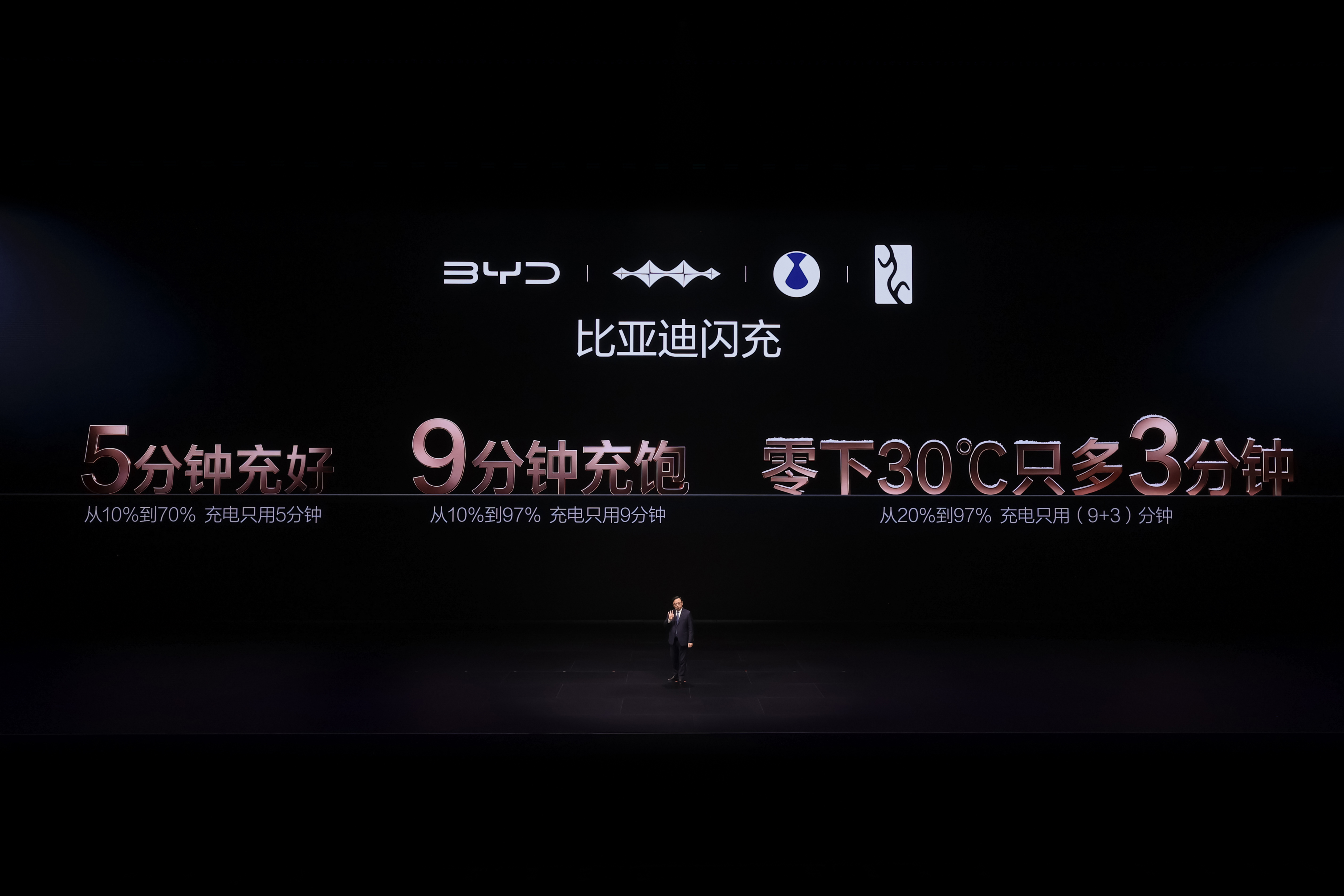
While people were still arguing over whether 800V is just a gimmick, whether an 800-kilometer range is really enough, and whether a 15-minute charge is truly fast, BYD used a launch event in Shenzhen, China's tech hub, to strip away the last three trump cards of gasoline cars.
BYD on Thursday unveiled its second-generation Blade Battery and flash-charging technology: one pushes LFP range past 1,000 kilometers, maintains performance in low temperatures without noticeable range loss, and enables fast charging without damaging the battery; the other directly boosts energy replenishment to “charged in 5 minutes, filled up in 9 minutes.” Even in extreme cold of minus 30°C, charging from 20% to 97% takes just 12 minutes—only three minutes longer than at room temperature.
Six years ago, BYD’s first-generation Blade Battery, with its safety claim of “no fire under nail penetration,” brought the LFP route back into the spotlight and ushered in BYD’s golden era of surging sales—by 2025, its global new-energy vehicle sales had surpassed 4 million units. Now, the second-generation Blade Battery and flash-charging technology are aiming to punch through the last line of defense for gasoline cars and tackle a host of electrification challenges.
Three Trump Cards of Gas Cars
Retail data from the China Passenger Car Association shows that although domestic retail sales of conventional gasoline passenger cars fell 9% year on year in 2025, they still topped 10 million units. With EVs pushing so aggressively today, why do gasoline cars still have such a large user base?
The answer isn’t complicated. This system—built around the internal-combustion engine and the fuel tank—has evolved for a century and genuinely holds onto a few core experiences that consumers find hard to give up: refueling is fast, and you can be back on the road at full strength in three minutes; range is long, so running over 1,000 kilometers on a tank doesn’t trigger anxiety; reliability is high—whether in bitter cold or scorching heat, you start it and go, with no range “discount.” This isn’t nostalgia; it’s real, practical value.
For a long time, EVs have seemed somewhat less confident when facing these “three mountains.” Either they piled on more batteries for range, making the car heavier and charging even slower; or they sacrificed battery longevity for faster charging—then when winter arrived, real-world range often depended on having a “golden right foot” to keep the numbers up. High performance, long range, and fast charging—one of the three always seemed to be the one you had to give up.
BYD’s second-generation Blade Battery is trying to take all three trump cards off the table in one go.
First card: fast refueling—or fast charging?
One of the core advantages of gasoline cars is that you can fill up in three minutes and be on your way—stop and go as you please. BYD’s fast-charging technology responds with: “Charge enough in 5 minutes, charge to full in 9 minutes.”
In terms of charging efficiency, at room temperature the second-generation Blade Battery can charge from 10% to 70% in 5 minutes, and to 97% in 9 minutes. By comparison, today’s mainstream 800V high-voltage fast-charging platforms typically need 15–18 minutes to charge from 10% to 80%. That means while other EVs are still waiting at the charger, BYD owners driving vehicles equipped with the second-generation Blade Battery can already “plug in and go,” much like a gasoline car.
Second card: Longer range—or longer anxiety?
Getting over 1,000 kilometers on a single tank is the sense of security gasoline-car users find hard to give up. With a 5% increase in energy density, BYD’s second-generation Blade Battery takes range up another notch: the Denza Z9GT reaches 1,036 km, and the Tang EV reaches 950 km.
Third card: Is it reliable in low temperatures?
For users in northern regions, the biggest concern with EVs is winter range loss and difficult charging. A gasoline car starts and goes no matter how cold it is; in severe cold, charging an EV can often feel like a luxury.
With BYD’s second-generation Blade Battery, in extreme cold of -30°C, charging from 20% to 97% takes only 12 minutes—just 3 minutes longer than at room temperature. That means from Shanhai Pass to Mohe, from Xinjiang to the Northeast, EVs are no longer shut out by winter.
“The days when EVs couldn’t make it past Shanhai Pass will be history forever,” Wang Chuanfu said.
It is worth noting that the second-generation Blade Battery’s fast-charging speed is achieved mainly through optimizations to the cell and the thermal-management system, rather than relying purely on a high-voltage architecture—by building a “high-speed lithium-ion pathway” and an “all-temperature-range intelligent thermal-management system,” it delivers lower heat generation and more efficient, more uniform heat dissipation.
On the safety front, the second-generation Blade Battery continues to emphasize extreme testing standards. Building on the first-generation nail-penetration test, the second-generation product further raises the bar: after completing 500 flash-charging cycles equivalent to roughly 300,000 kilometers of use, it then undergoes an extreme test in which it is nail-pierced while charging—and the battery still remains stable. The battery also passed a thermal-propagation test at four times the new national standard and an underbody impact test at ten times the new national standard, with no fire or explosion in either case.
With that confidence to back it up, BYD also announced a further upgrade to its battery warranty policy: for the second-generation Blade Battery, the overall “capacity retention rate” guarantee has been raised by 2.5%, while the battery cells still come with a “lifetime warranty.”
The handful of core experiences that ICE vehicles have long depended on for survival are now being answered one by one by new technologies.
BYD's 20,000 Flash-charging Stations by End of 2026
No matter how strong a battery’s performance is, it’s still just numbers on a spec sheet. Even with the world’s most advanced battery in hand, if users can’t find a charger—or can find one but it charges too slowly—then all those technical specs are nothing more than talk on paper.
To address this pain point, BYD has also put forward a solution.
The flash-charging pile released this time delivers a peak charging power of 1,500 kW per connector, making it the world’s highest-power mass-produced single-connector charging pile. But even more noteworthy than the power figure is the integrated energy storage-and-charging system inside, built around a second-generation Blade Battery. The logic is straightforward: during grid peak-load periods, the battery acts like a “reservoir,” storing electricity; when high power output is needed, it serves as a “power amplifier,” releasing electricity. Under the same energy-supply conditions, a single flash-charging station can serve about 50 vehicles per day on average, with charging efficiency roughly 10 times that of ordinary charging piles.
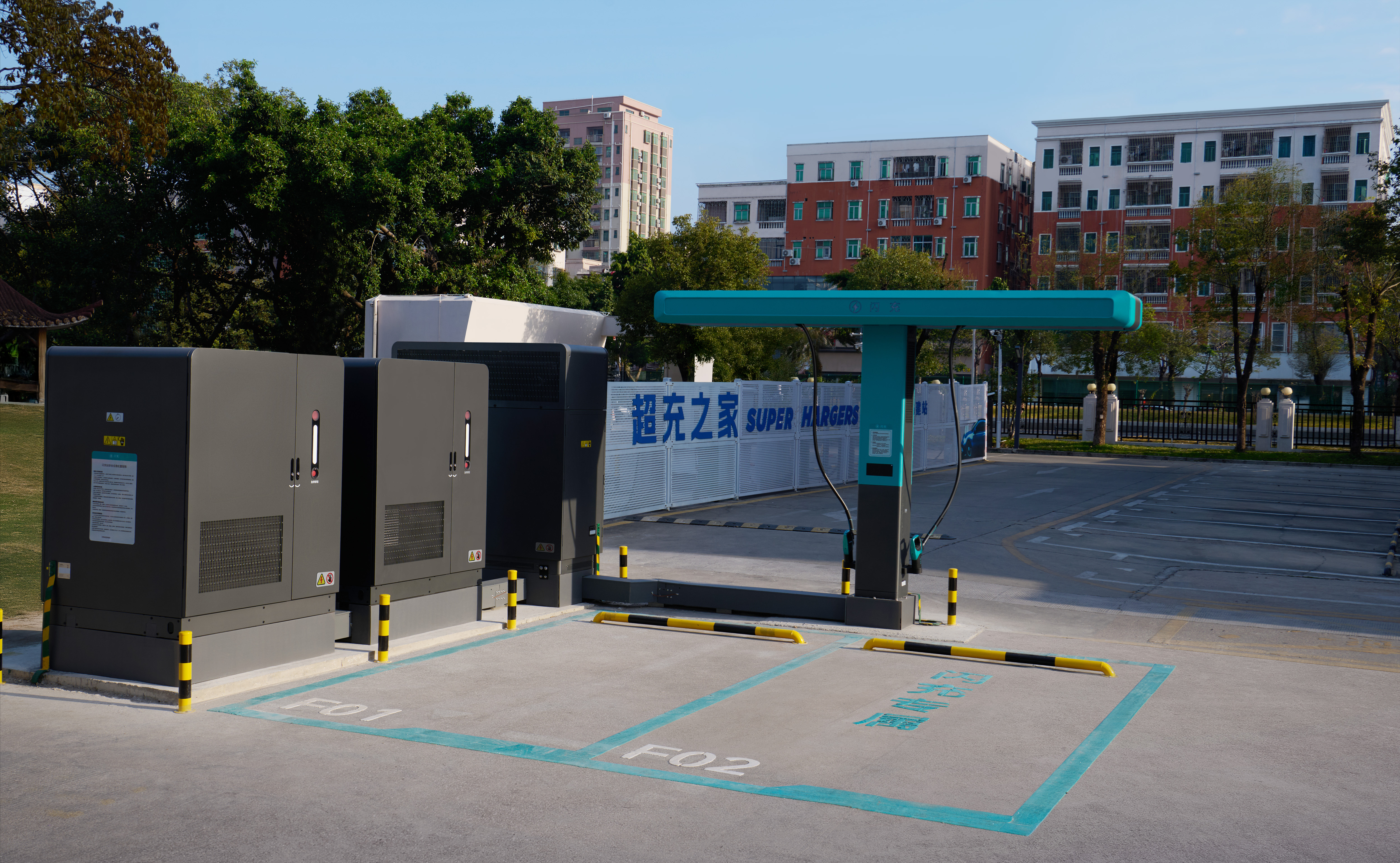
BYD flash-charging station
This means that while other EVs are still lining up for standard fast chargers, BYD owners driving models equipped with the second-generation Blade Battery can already pull in like at a gas station—“pull up and plug in, plug in and go.”
According to the plan, the first batch will include 10 models equipped with the second-generation Blade Battery, spanning multiple product lines from the Seal 07 EV to the Yangwang U7.
According to the plan, by the end of 2026, BYD will have built 20,000 flash-charging stations nationwide, advancing on two parallel tracks.
The first track is the “mid-station flash-charging” model, implemented in coordination with nationwide charging-network operators, with an estimated 18,000 stations to be built. The core logic of this model is essentially “leveraging existing strengths”: building on today’s public charging stations while overlaying BYD’s flash-charging capability to scale up quickly. The goal is crystal clear——to let users enjoy a generational leap in charging speed in the charging scenarios they already know. Under the plan, Tier-1 and Tier-2 cities will have a flash-charging station within 3 km; Tier-3 and Tier-4 cities within 5 km; and Tier-5 and Tier-6 cities within 6 km. For residents across 90% of urban areas, flash-charging service will be available within 5 km.
The other track is “flash-charging highway stations,” with an estimated 2,000 to be completed, covering nearly one-third of expressway service areas——on average, one every 100-plus kilometers.
What surprised the market even more was the timetable: before the May Day holiday this year, the first batch of 1,000 highway flash-charging stations will be completed and put into operation。
To make the offering more compelling, BYD also rolled out accompanying policies: owners of flash-charging models equipped with the second-generation Blade Battery will receive one year of free flash-charging benefits starting from the vehicle’s delivery date. After the free period ends, pricing at flash-charging stations will stay aligned with industry standards, with no additional fees.
Wang Chuanfu also revealed a “peer plan”: “As long as four owners request a flash-charging station, BYD will build one nearby for them. After all, building a flash-charging station isn’t complicated——it’s as simple as installing an air conditioner.”
A Rival’s Dilemma: Follow, or Not?
Generational technology shifts never wait for anyone to be ready.
When BYD unveiled the second-generation Blade Battery and flash-charging technology at this launch event, it was no longer merely a product refresh by a single company; it threw a very real question at the entire industry: under this new technological coordinate system, how should other players respond?
For competitors, it’s a classic dilemma.
First, the competitive landscape on the battery side is being rewritten. Higher energy density, stronger fast-charging performance, and improved low-temperature degradation are loosening the old division of labor in which ternary lithium “stood for performance” and LFP “stood for cost.” For companies that once found room through differentiated positioning, the track is getting narrower.
If they choose to follow up, the first hurdle is technical accumulation. The second-generation Blade Battery involves a systematic optimization of the materials system, cell structure, and manufacturing processes—it is by no means a simple parameter upgrade. Capabilities such as lithium-ion channel design, coordinated thermal management, and an integrated “storage-and-charging” architecture are the product of long-term R&D investment and engineering validation. For automakers that rely on external supply chains, achieving comparable system-level performance is far from easy.
The second hurdle is cost. Backed by a vertically integrated industrial chain, BYD holds clear advantages in battery cost and integration efficiency. Competitors that depend on external procurement will struggle to obtain the same economies of scale; if they opt for in-house R&D and manufacturing instead, that implies massive spending on research and capacity—making it difficult to build equivalent competitiveness in the short term.
The third hurdle is ecosystem capability. A plan for 20,000 flash-charging stations, storage-and-charging integrated systems, and a coordinated car-to-charger experience mean this is not only a technological breakthrough, but also a full-fledged systems project. For companies that have yet to build an energy replenishment ecosystem, the gap they need to close is widening rapidly.
If they choose to wait and see, they will face pressure as well.
For automakers that lack foundational cell R&D capabilities, a technology gap may translate into a gap in market perception. As consumers gradually form an expected standard of “fast charging, stable performance in low temperatures, and long range,” products that cannot meet these benchmarks may be pushed to the margins. Once such perceptions take hold, they are hard to reverse through marketing in the short run.
And for traditional automakers that still rely on gasoline vehicles as their core business, the window for transformation is narrowing faster too. In the past, EVs’ shortcomings in replenishment efficiency and low-temperature performance were once key advantages for gasoline cars. But as these weaknesses are gradually addressed, users no longer need to choose between convenience and electrification, and the market space for gasoline vehicles will continue to be squeezed.
Over the past few years, the new-energy industry grew accustomed to a “let a hundred flowers bloom” narrative——you have your three-electric technologies, I have my smart features label, and he has his user operations. Everyone seemed able to find room to survive in some niche track. But when BYD pushes batteries, charging, high-voltage platforms, and electronic-control efficiency to a new level across the board, that one-dimensional room for survival may shrink sharply.
Of course, this does not mean other companies have no chance. The evolution of technology routes has never been a single path: breakthroughs in LFP do not mean other approaches lose value; building out charging networks takes time and capital and is not impossible to catch up on; and there are multiple ways to improve user experience. But for the industry as a whole, the competitive baseline has indeed been raised.
The first-generation Blade Battery six years ago answered the market’s safety concerns; today, the second-generation Blade Battery and fast-charging technology respond to doubts about charging efficiency and low-temperature performance. This is not the finish line, but a waypoint in the evolution of the technology. For other players, the real question to think about is how to find their place after this inflection point.
To follow means having to catch up across multiple dimensions—technology, cost, and ecosystem; not to follow means potentially having to accept being pushed to the margins in certain market segments. There is no standard answer to this problem, but the competitive landscape at the table has indeed changed.
 LIKE 1